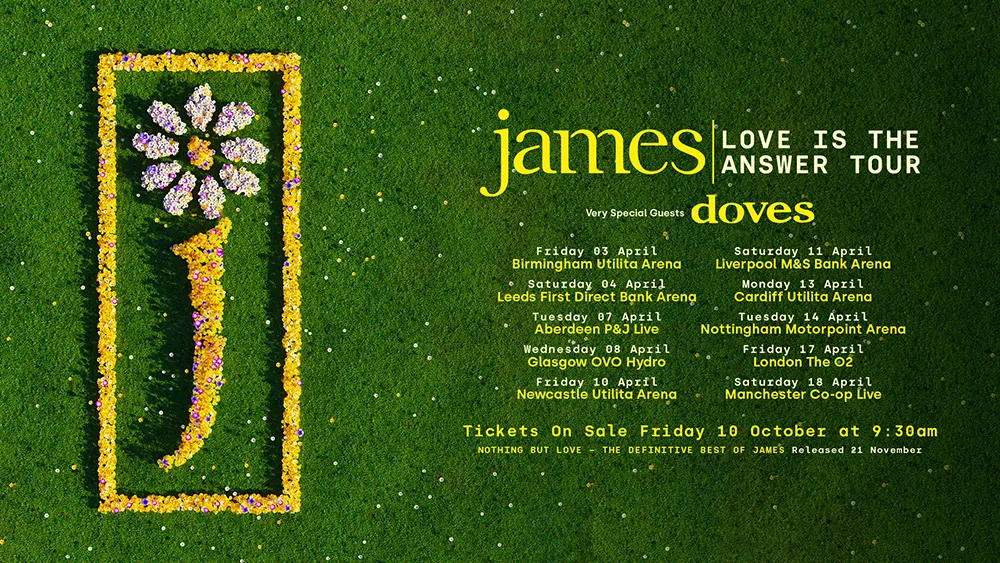
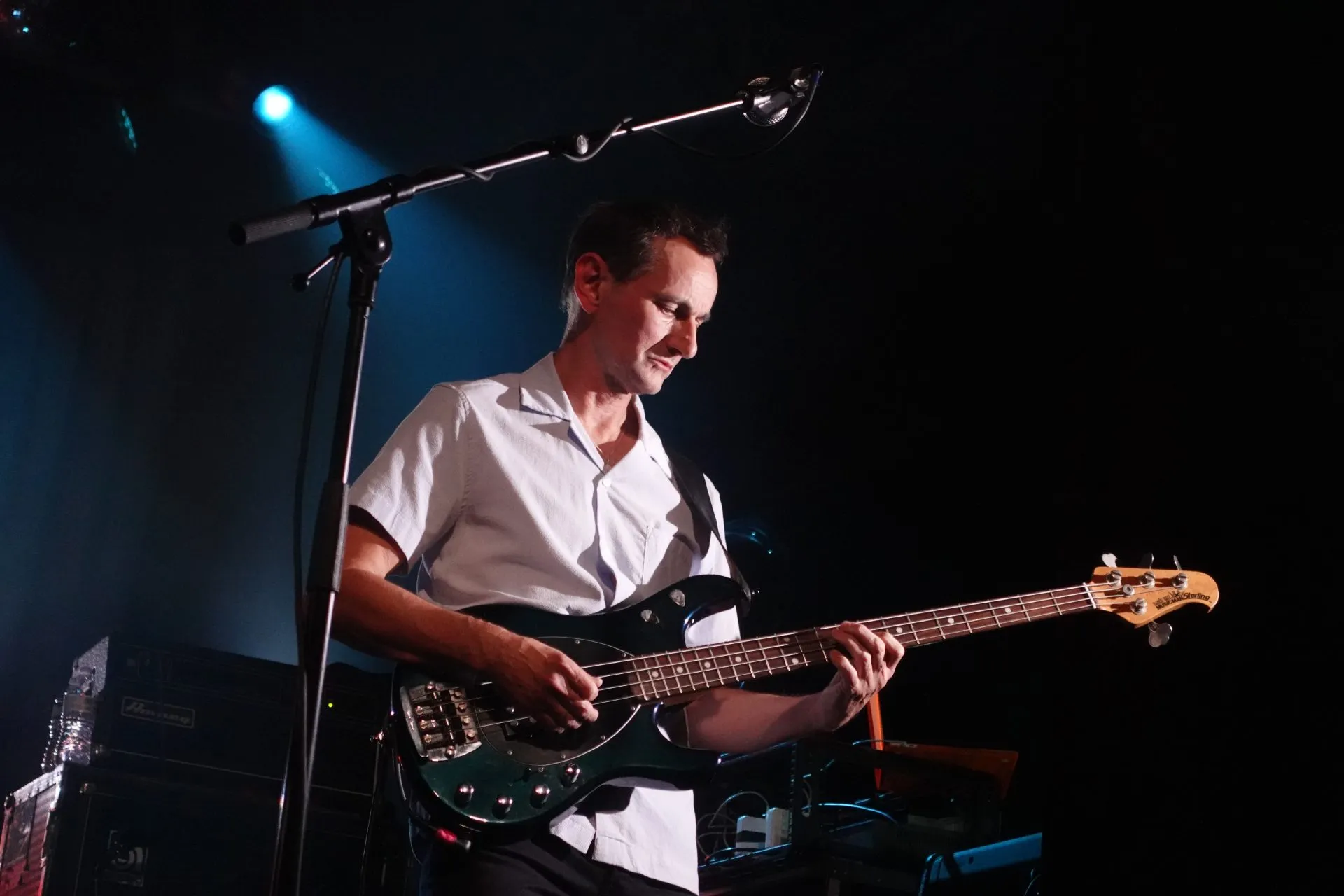
Last year was potentially the busiest James have ever known. Although they didn’t release a new studio album, the band still found time to put out a live record and an expansive 58-track compilation. Alongside those releases came an extensive run of shows across the UK, Europe, North America and Latin America. And with a UK arena tour on the horizon, 2026 is already shaping up to be just as packed. We sat down with founding member and bass mainstay Jim Glennie to talk about the upcoming dates – from reshaping older material to their love of keeping the setlist full of surprises.
How are you feeling – a bit more recovered after what was a pretty mad 2025?
Yeah! It’s been bonkers. The last few years, really. It kind of picked up pace when we were celebrating the 40th anniversary and it hasn’t stopped, really. I thought that’d be a relatively short burst of excitement and then everything would kind of slow down, but that hasn’t really happened. Good, though! I mean, there’s been some amazing things. Certainly not complaining!
It’s not long now until you kick off the year with the rescheduled Kingston and Liverpool shows…
It’s a shame about all that. It’s annoying as well because I know some people obviously have wanted to come first time around and can’t come for the second dates and everything. Yeah, we were battered by that illness. I don’t know what it was, whether it was just flu, but we got hammered by it. I mean, we weren’t the only ones, there was a lot of it around, but yeah, it just worked its way through.
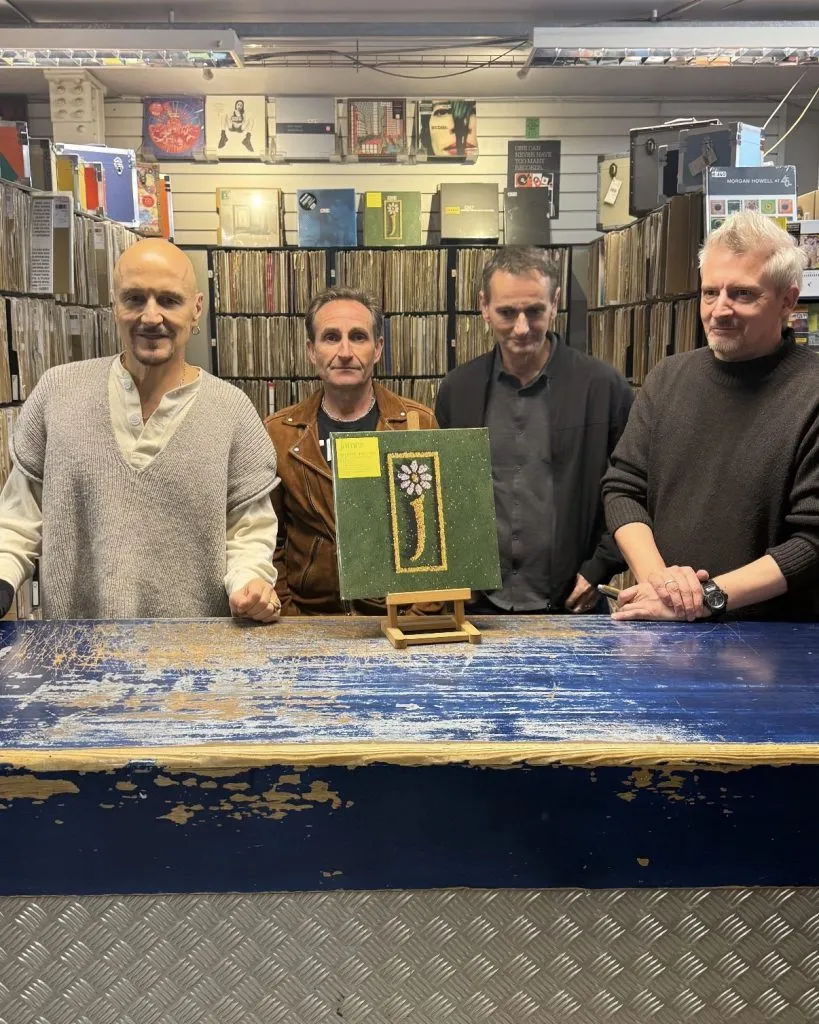
I remember Mark looking a bit under the weather at your Manchester signing, and then you all went down.
He said he wasn’t feeling great, but I think he was downplaying it. The next day in Leeds we initially isolated him, then sent him home. We had one day where everyone seemed fine, then Tim and I woke up with it. After that, Tim and I isolated, and then Saul and one of the crew came down with it too. At that point it was obvious people had already picked it up – it was just working its way through the system.
It’s a bad time of year for viruses, isn’t it?
Yeah, I mean, I was really ill with it – properly floored. For about three days I was just… awful, absolutely awful. And it took a while to come out of it too. I’d say it was a couple of weeks before I was 100% the other side. But hey-ho – still alive, just about!
Not the best end to such a good year!
No! That was just before Christmas, so at least I wasn’t ill over the holidays. I was speaking to someone the other day who had it over Christmas, so I’m thankful for small mercies, I think!
It’s good that you’ve been able to reschedule both shows – they almost feel like little warm-ups now.
They’re fairly close to the arena tour, which breaks the ice a bit. We’re about to do a week’s writing – that’s kind of the first thing where we’re back up and running again. Then there’s a couple of days after that, and we’re straight into promo, doing all that and the rest of it. And yeah, the year’s been filling up. There’s obviously the arena tour, then festivals again in the UK and abroad, and we’re working on the new record, trying to get the songs sorted out in the gaps as best we can.
How much rehearsal time do you realistically get as a full band before you go on a tour of this scale?
It’s usually up to us, and the warm-up gigs are really important because you’ve got ideas and concepts about what you want to do, but you have to play them live to find out whether everything’s actually going to work. We want to introduce a couple of new songs into the set for the April tour – properly new songs – so that’s going to be a bit scary, and they need playing in front of people for the litmus test. You can bang through them as a band and go, “oh, that’s great,” but when you put them in front of people it’s different. That’s the litmus test – that’s when you realise whether the song is ready and can stand on its own two feet or not. That’s part of the plan, really. To some degree we don’t do loads of rehearsing – we’ve got better over the years, but we’re still not particularly efficient at it. I think it just expands to however long you’ve got. If you give us a fortnight, we’ll be busy for a fortnight; give us three days and we’ll do it in three days. It tends to be a few days.
Are your rehearsals more about setting a framework than nailing every detail?
We don’t rehearse like some bands – just batter, batter, batter. We’re not running through the set over and over, because first, we don’t need to, and second, you can just get bored with the songs. It’s counterproductive, as far as we’re concerned. You run through something, perfect it, and then you don’t want to play it anymore. That’s just the way we work. We’re almost the opposite of most bands, who want everything perfect in their heads – flawless, faultless. We don’t want that. That’s the last thing we want. We want things to stay a bit open-ended. It’s almost like you’re saving the best for the gig. You don’t want to be at your best in rehearsal – you want to build it up to that point, and then stop. And then when you get on stage, you’ve got that adrenaline, you’ve got that excitement, and hopefully the best performances – the best versions of the songs – come out. But if you push it to the best and keep going, and keep going, it just kills it. You’re just like, “I don’t want to do that anymore. I’m fed up with it.”
You can tell when it’s no longer fun and an artist is just going through the motions.
We’re there every night, so selfishly you have to keep it fresh. You have to find ways – games you play with yourselves – to make it as exciting, interesting and valid for you as you possibly can. You’re all there, you’re present. And that’s where new songs and old songs come in. There’s that moment where you look at the set and go, “oh, fuck.” You’ve got copious notes trying to remember whatever it is you’re about to play, and it’s scary – but it wakes you up. It keeps you alert, keeps you present, keeps you there. And I think that’s what pulls the most out of you as a musician. Yeah, you fuck up sometimes – but who cares? The audience love it. As long as you don’t go into a shitty headspace because of it, which is easy to do if you’re not experienced to some degree. If you let it, it’s like you’ve taken bad acid – it’s horrible up there when things go wrong and you listen to that internal dialogue. You’re fucked. It just spirals down into thinking you’re the cause of all the problems in the world. It’s really not a nice place to be. But with practice, and through repetition, you get over that. The mistakes become funny. They become part of who you are. And I think people appreciate that. They know it’s live. They know you’re really playing and that things can go wrong.
It’s nice for the fans who come to more than one show as well. You could follow an entire tour and not see the same set twice.
That’s another advantage of it, really. Obviously people come to more than one show on the same tour, and they’re not going to get the same thing. You’ll get different songs, different versions of songs, and a different experience each time. Wherever we are, the journey we take will be different. And yeah, I think we have to do that. I don’t think we’d still be here if we weren’t – I think we’d have got bored. It would be soul-destroying after all these years, I think, if you didn’t have that approach. You need that excitement.
Will the setlist for the arena tour lean heavily on the Nothing But Love – The Definitive Best Of compilation, or is there room for surprises?
I think there will be surprises. Obviously, The Definitive Best Of isn’t a “best of” in the traditional sense. It draws on a lot of material that technically isn’t made up of singles and all the rest of it. So I think we’ve got plenty of scope to dip into that, pull things into the tour, and keep it quite varied. But I still think we’ll do a load of things that aren’t on it. Even though we’ve got 58 songs to choose from there, I’ve got a sneaky feeling there’ll be another 20 that aren’t on it but are still in the pool! We also want to get some new stuff in, so we’ll probably try to throw a couple of new ones into the set as well.
What about the two new tracks from the compilation? Will they become staples, or are they more moment specific?
‘Hallelujah Anyhow’ is doing really well at the moment. It’s just been A-listed at Radio 2, so it’s going to get fairly heavy rotation, I would have thought. So we’ll probably do that. We haven’t actually played it live as a band yet. We’re looking at at least one fully fledged new one, which will be from the next record, I guess – that’s kind of coming together behind the scenes. We’ve got the writing session coming up, which will be the last one for this record.
Are you heading to Yorkshire again?
Yeah, it’s a big house up on a hill in the Yorkshire moorland, and it’s fucking brilliant – just perfect. You really feel like you’re away from everybody and everything. It feels dramatic, and there’s a great sense of space too, because you’re high up on the valley side, so the views are really expansive. It’s really, really good – really nice. It works brilliantly for the room we play in. So yeah, we’ve got a week there, basically – the four of us – which is exciting. And in the gaps, we’re trying to push the record forward, push the songs on. We’ve already got loads of demos, and it’s sounding really good. Tim’s pulling the lyrics together and he’s really, really happy with where everything is. So yeah, it’s this final batch of writing, and then, somehow, in whatever gaps there are between everything else this year, we’ll try to get it finished. I don’t know when – God knows, I don’t know. We’re also looking at producers, so their availability will probably dictate when we can actually do it and finish it off.
When you add older songs to the set, do they immediately click again, or do they need to be re-learned almost from scratch? I remember you playing ‘Burned’ at a soundcheck once.
You might remember bits of it – maybe a starting point – but with arrangements, structures, changes and things like that, you definitely have to go back and relearn them. That does take a little bit of time. Sometimes you can kind of busk it off the cuff, but sometimes you can’t. Sometimes you just can’t remember the changes, or you can’t remember where the changes come in, so everybody comes in at the wrong time and you have to put a bit of work in.
Once you’ve relearned them, how do you decide whether to keep a song close to the original or let it evolve?
With the old songs, sometimes we just leave them as they were, and sometimes – quite often – we don’t. We let things move on and change, and we kind of feed in the other musicians who probably weren’t there on the original recording. A lot of the early songs, when you go back to them, are pretty sparse. The sound is spindly, you know – it’s kind of thin and tinny – and I love that. When I listen to those early James recordings, like Stutter and the singles from that period, there’s something really special there. But we’ve moved on – we’ve changed, for better or worse – and evolved into a different area. I think some of those songs, when you put them into a new format, work a treat. What they become is a very different version of the song, but sometimes you want the opposite. Sometimes you want to recreate that spindliness, that smallness, and I think that can be really impactful and effective in big shows. It’s counterintuitive, because it’s very easy to want to go big all the time – loads of people, quick, bang it out, everybody playing, loads of bells and whistles. But I think getting small pulls people in. Reducing the number of people playing, or stripping back the sound and instrumentation, draws people in again. And I think that contrast makes it more impactful. So it kind of varies, really.
Are there any songs from the early days that you’re keen to revisit on this tour?
It’s kind of nice going back to those songs, going back to those stripped versions. Tim was talking the other day about songs we might look at – he suggested ‘Chainmail’, and I suggested ‘If Things Were Perfect.’ You know, it’s like, yeah, remember them? We haven’t played them for a long time, but I can remember them. It’s also kind of like you get pulled back into that period of your own life, your own existence. It’s like a time machine, isn’t it? You get zipped back to where you were, who was around you, and who else was in the band. I suppose that’s one of the great things about music. There are soundtracks to periods of your life, aren’t there – songs. And they are for us too, even though there’s something slightly different going on, because they can also mark the beginning of a change, I guess – the beginning of a different version. Those original, crystallised initial versions really belong to a specific period. I find that really interesting. I think it’s a cool thing not to abandon – to not just say, “Yeah, we’re going to do it with everybody,” and pile loads of musicians onto everything. Sometimes it’s important to keep things stripped back.
Revisiting songs, do you find yourself listening to your bass parts with fresh ears?
And again, try to be appreciative of it. Don’t go, “Oh, I wouldn’t do that now, so change it all.” You know, I don’t want everything to suddenly go through a filter of where we’re at now. I think it’s cool when stuff is updated and things are changed, and when a different version comes in – that’s absolutely fine, and that’s very valid. But at the same time, I don’t think there’s any point in losing anything. Whatever you had then, you know, I think you’re leaving something behind if you just gratuitously go, “Oh, I wouldn’t do that now.” And I like a lot of that stuff. I like a lot of what I did back then – very different approaches. So I’ll always start by learning exactly what I did. I’ll fathom it out and write down the arrangement of the songs, and I’ll begin from that original place. If we decide to take it somewhere else, then so be it. But if we’re going into rehearsals with it, I’ll know exactly what I’m going to do. I’ll have the sound sorted out, and I’ll be clear on my part. That’s the starting point.
You reshaped Laid when touring North America – has that experience influenced how you now approach songs that haven’t been played live for a long time?
It was an interesting test for us, really, because that’s not something we’d ordinarily do. You know, you end up having to play a bunch of songs, and you have to play them – you’ve sold the ticket based on the fact that you’re going to play the album Laid, so you have to play the album Laid. And we just never do that. We’re never forced to play one song, let alone bloody thirteen, you know? So it was a slightly strange experience, and I think we were a bit wary of it. Doing something like this has been suggested for donkey’s years – probably at least the last ten years – “Let’s go and play an album in its entirety,” and we’ve always gone, “No, not doing it.” So yeah, it was a strange one – but wonderful.
Did committing to playing the album in full change how much freedom you felt you had with the arrangements?
We allowed some of the songs to change but kept others as they were, trying to stay true to the ethos and essence of what Laid was. We shuffled the order around – it worked for the record, but live the dynamics of the ups and downs weren’t quite right, so we changed it. Some songs were allowed to move on and become slightly different versions, and others we kept true to the cause. You have to do a lot of rehearsing for that. There were songs on there we’d never played live before, so it was about figuring out: how do you make that work? Can you make that work? There was a lot of time at home again, really, playing on my own, learning everything, making copious notes, working out exactly what to do, where and when – and then letting it change from there. But letting it change from a point of knowledge, rather than just going in and busking it. Really honing in on what we did on the original.
Not at all, it was really well done – you could tell a lot of care and work had gone into the new arrangements. And of course, Chloe led vocals in a song for the first time.
It was nice, and Tim had a little break there – he could just sit and catch his breath. It was nice to give her that song as a feature. I mean, she’s wonderful, the way she’s slotted in and fitted with the band. Amazing, really. I love working with her on the new songs as well. She plays a big role as the songs are coming together, even at the demo stage. She’s layering up backing vocals and giving the songs a really big impact.
She did an excellent job on Yummy.
She did. And as I said, sometimes when we do demos, we know there’s a good song in there. You can hear that there’s the basis of a good song in there. But sometimes it’s quite further down the line that you actually kind of deliver that song, that the song is, yeah, wow, you know, we’re going to impress people. But we, because we’re doing it for thousands of years, we can kind of identify things at quite an early stage of that kind of existence, really, I suppose. But Chloe, when you send it to Chloe, you come back and it’s like, bang, it’s just moved on massively. It’s like, wow. And it’s delivered. What you were hoping would happen has happened in a really unexpected way. She’s very clever. the way she works her vocals and layers harmonies in such an unusual way. And not just harmonies, harmonies is not doing her justice really. There’s separate vocal sections and melodies. She’s not just harmonising. But in an unusual way, it’s not the blind and the obvious, as you know, she quite often falls into backing vocals, you know.
When you’re putting a setlist together and deciding to bring older songs back into the mix, how do you approach integrating Chloe – and Debbie as well – into those arrangements, given they weren’t originally part of the band?
Usually we give them free rein to see if they can find somewhere to fit in. Or Tim might say to Chloe, “It’d be great to have you help me on this section.” That way, a section can get another lift, because Chloe will kick in behind Tim in some way. Sometimes we just leave them to find their feet as we’re working through the song, letting them see if they can come up with ideas while we’re bashing away and trying to learn it. Sometimes they find something, sometimes they don’t. So it’s pretty much up to them, unless there’s a specific thing missing from the record or a section that needs some help. And sometimes there is. You drift into a section and you’re not quite sure what you’re doing there, or why. That’s when you need a contributor – someone to come in and just batter through it, give it some character and identity.
They’ve clicked perfectly, on stage and off – it’s like they’ve always been there.
Amazing. Yeah, no – when Debbie joined us, it was fairly obvious early on that we really, really liked her energy. From our perspective, it was almost like a catalyst. It changed the nature of how we all related to each other musically. It’s mad, really – she just stirred everything up. A new energy was injected into the band, which is blindingly obvious, because that’s what she brings. She’s just a bundle of energy. And Chloe’s very different. You wouldn’t automatically think, “Okay, Debbie works, so Chloe will work as well.” You wouldn’t presume that by any stretch of the imagination – but she just did. She loves it. She absolutely loves doing stuff with us. I think it took us some time to work out exactly how to lock in and click together, partly because we were initially handing her Debbie’s job. There was a lot that was new to her, and some of it was probably a little outside her comfort zone. But then the roles changed, the roles expanded, and we ended up with both of them, which is brilliant. The two jobs are very different. Debbie can do backing vocals, but she’s a drummer; Chloe can play percussion, but she’s a singer. So it’s a bit of a no-brainer, really. And yeah – it’s wonderful having them. It’s really, really wonderful.
Your improvisation is part of why you’re such an exciting live band. When things start to open up and the improvisation kicks in, is your mindset to chase what’s happening in the moment, or to keep things grounded?
It’s to chase what’s happening – to push it, really, or help push it further, whatever’s unfolding. It feels like a door opens. It’s almost like you’ve stepped into another room.
When you’re in that space, how much of it is instinct rather than conscious decision-making?
Because we’re used to doing it now, you instinctively follow things musically. You’re not really thinking about what you’re doing; it’s more about listening, responding, reacting. Your hands and your musical ear are faster than your brain in that moment. I’m not sure it’s a great idea to start thinking about it, to be honest. You just have to go with it, flow with it, and see what happens. Sometimes it’s great, and sometimes it isn’t – sometimes it crumbles and falls apart. But no, I don’t try to hold it down. Occasionally you can do that, especially if it turns into a musician improvising and you think, “Right, I’ll start doing this.” But most of the time, we’re not really looking for an individual to improvise. We’re not after that “off you go” moment, like a big solo – even though that can happen sometimes, whether it’s guitar or violin or whatever.
So it’s less about individual players, and more about where the song wants to go?
Generally, we’re looking for the song itself to go somewhere – for it to move into a place it’s never been before. When the song jumps, everybody jumps. You’ve just got to be ready for that moment, ready to go, “Oh, we’re going here now.” Your hands try to follow what your ears are hearing. I don’t have perfect pitch – I think Mark does, possibly Adrian – but I don’t. So if someone goes to an A, I don’t know it’s an A. I just know something’s changed, and I’ll change too. I might hit the right note, I might hit the wrong one – and the wrong note can be genius. If I knew exactly what I was doing, I could probably land on it deliberately, but I don’t. So it’s an accident. And accidents – collisions – can be amazing. They can be way better than anything you could sit down and calculate. Brian Eno used to talk about this – “Honour thy error as a hidden intention.” If you’re thinking your way through everything, you’re limited by your knowledge and experience. But if you throw yourself in and stay open, accidents happen, collisions happen, and things emerge that are completely unexpected. That’s what makes it exciting. But you have to allow it to go wrong. If you’re not making mistakes, you’re not trying hard enough. You’ve got to push yourself to the point where things occasionally fall apart – otherwise you’re not really on the edge.
I think your onstage chemistry really helps with that. Would you say that’s changed over the years – the band’s chemistry and the way you communicate?
I think, certainly over the last few years, the chemistry onstage has changed a lot, and the relationships within the band have changed too. We’re much more supportive of each other now – and more openly supportive. There’s always been an unspoken, collective sense of responsibility, but the support feels more visible now. It’s just more open. I think when we came back together after the break, after we split, we were all aware that we needed to be more supportive – musically and as people, in our lives as well. Helping each other out, being aware when someone’s struggling, and feeling able to share that. People feel they can open up, and that others will step in and help. That’s definitely changed. And I think that’s had a real impact on how we are and how we play. It still feels like we’ve got stuff to do, stuff to get right. There’s still room to improve. I don’t feel like we’ve reached some kind of “perfected” version of ourselves – I’m not even sure what “perfected” really means. That idea feels static, like, “Here we are, this is the finished version.” But it’s not like that. You just keep going, don’t you?
I don’t think you’d ever be happy. You’d never find the perfect version, because you’d just keep going.
I think so, yeah. And running in to smash things up and piece them back together again – I’ve always wanted to do that. Not trying to arrive at something that’s repeatable every time, because that just becomes formulaic. And that feels like the beginning of the end, really. It just sounds like the wrong place to go.
It sounds like that would get boring pretty quickly.
Yeah. Trundling through the motions just sounds awful – it sounds painful.
Last question – do you prefer touring now or in the earlier days?
Now it’s less destructive. Back then, it was quite destructive – full-on. And it’s easy for that to happen. I think it was damaging. There was a lot of fun in inverted commas, but yeah, it was damaging – damaging to individuals, damaging to our health. And it wasn’t sustainable. I think what we’ve been conscious of since we came back is finding a version of James that can keep going – that isn’t a car crash, you know what I mean? Back in the ’90s, it felt like careering down the road, desperately trying not to skid off into the abyss. Now it feels a lot more solid. And it’s nice – we’re that much older as well. We need to look after ourselves.
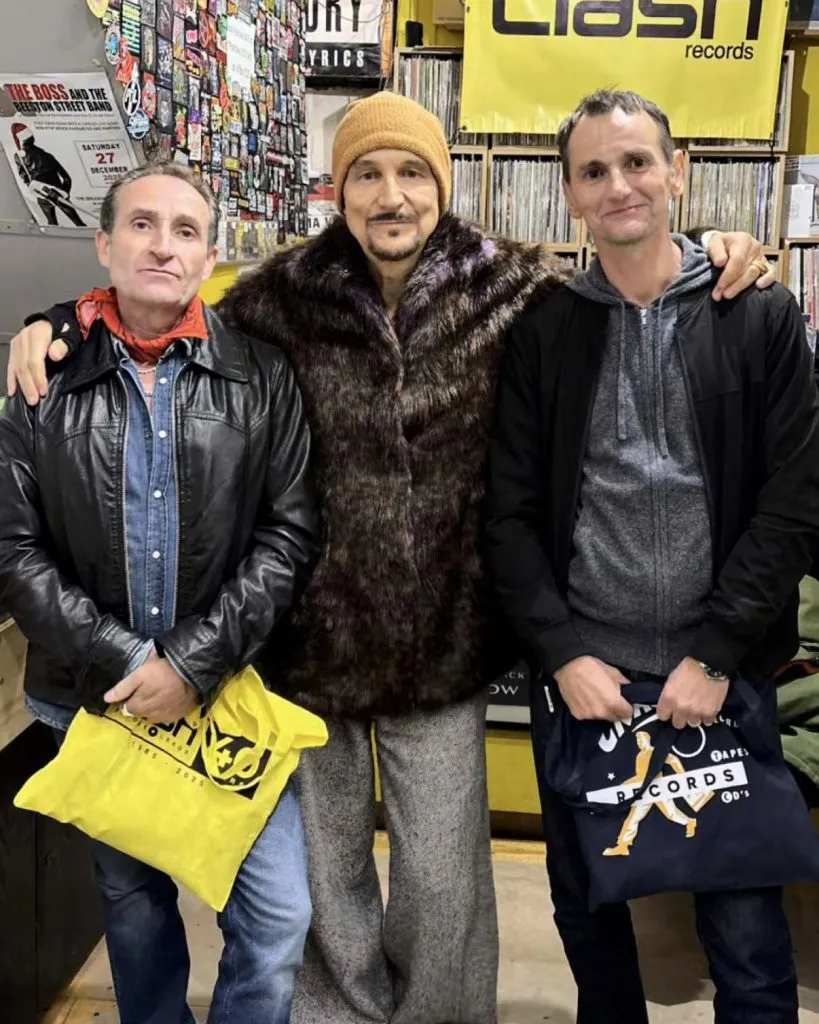
Looking back at old photos from the band’s formation, it really brings home how young you all were – and how easy that is to forget.
We were. We started at that point, you know – we were immature, stupid, childish. And this is an amazing job, it really is, and we very nearly fucked it up back then just through being stupid. So I’m really grateful for what we’ve got now. I think we all are. We appreciate it a lot more, and as a consequence, we appreciate each other a lot more too. I’m glad I did what I did. I’m glad I went through that chaos – I would not want to go through it again, ever, thanks very much. We’re better for it, though. Stronger, wiser, older, and we grew up. That experience helped us grow up. The split helped us grow up. We came out of it as very different people, with very different attitudes. I think initially as well, treating the band as something fragile, because we realised it could break. In the ’90s, it felt almost indestructible, and then we learned that it wasn’t. So when we came back, it felt quite delicate. But over time we started to build again, and now it feels strong. I don’t know what happens going forward for us, but it feels like we’re here for a good chunk of time yet. We’ve got a lot more new music – albums of new music. If it’s albums of new music, you’re talking a good number of years. And that feels good.