My first glimpse of Brighton’s The New Eves came with them tucked between chancel and nave beneath the icons of St Pancras Old Church, opening for Laura Jean. Four strangers in white, bows flashing, drums rattling, oddly compelling voices volleying off vaulted stone. One memorable song (I later learned was ‘Cow Song’) felt as if a sliver of folk-horror had drifted in from Midsommar, only here it beckoned rather than threatened.
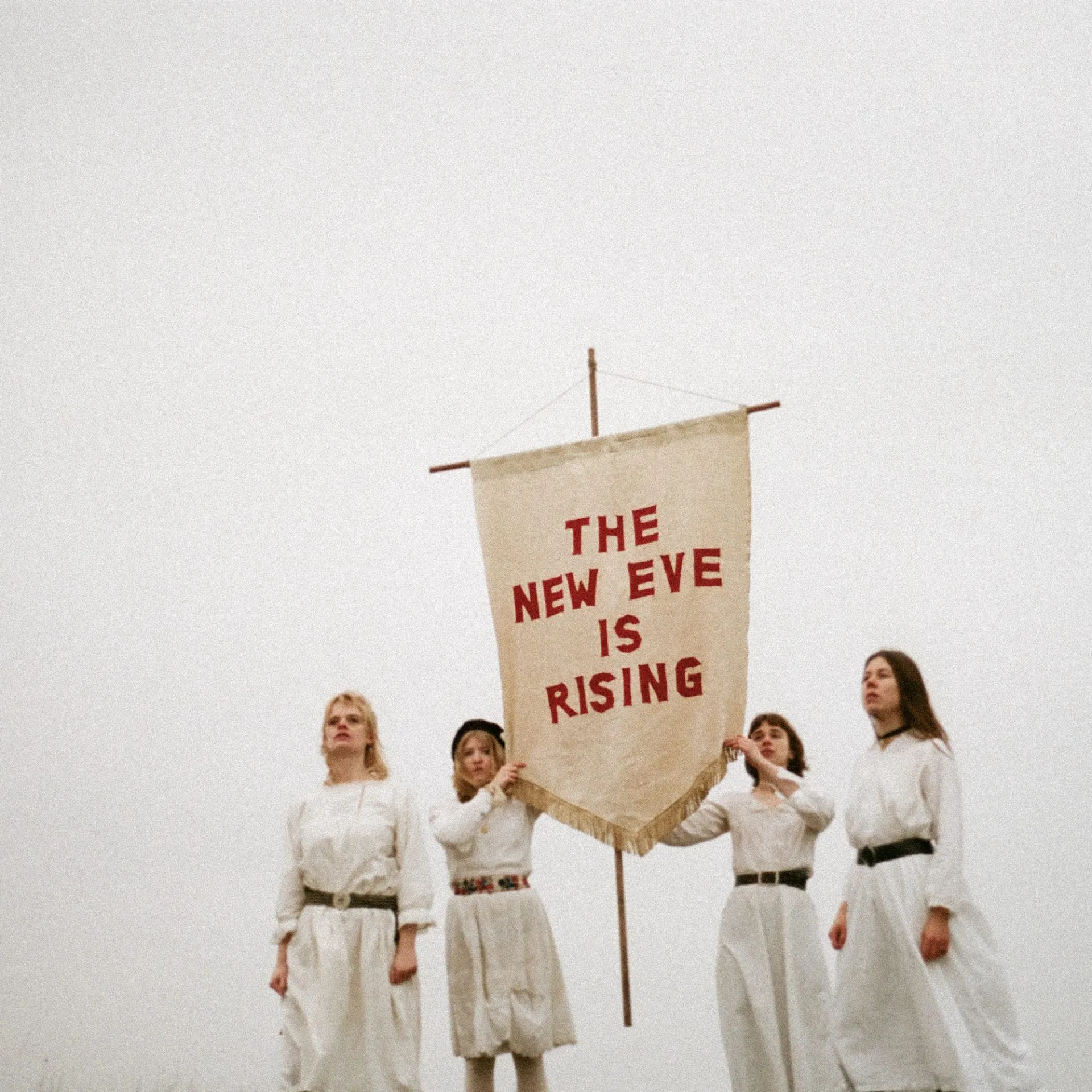
Three years on and some distance travelled, their debut The New Eve Is Rising captures that first cognitive jolt and forges it into something even more elemental. The cover sets the tone: the band hoisting a hand-stitched banner against a blank sky, scarlet text “THE NEW EVE IS RISING” flapping like a weathered omen. Inside lie nine different takes on their self-styled “Hagstone Rock” named after the magical sea-worn beach stones used for protection. Recorded between Bristol’s echoing Cotham Parish Church and Rockfield’s furnace-warm rooms, each track plants its feet somewhere: a field, chapel, hillside, a dream, and lets those spaces seep into one another.
Opener ‘The New Eve’ is more like a spell, or manifesto than song. Over cello drones, Nina Winder-Lind recites:
“The New Eve fucks /The New Eve fucks if she wants to / The New Eve says no if she doesn’t want to and there is no god to save you / if you fail to listen. The New Eve has autonomy / over her soul and her body. The New Eve has learned to scream / to stand straight, to sing, to speak.”
Forbidden apple seeds are replanted, blame shrugged off as violin chatters sky-ward and a guitar, recorded beneath altar lights, screams the song’s last breath. A brief pause, then Ella Oona Russell’s tattoo-drum yanks us into ‘Highway Man’, flipping poet Alfred Noyes’ English Lit staple so the woman “takes the night for herself”. Violet Farrer’s violin spits blue-white sparks across Kate Mager’s low-flying bass while the chorus whoops like riders cresting a heath.
The aforementioned ‘Cow Song’ still mesmerises in the context of the album. Its opening Scandinavian kulning ululations (captured outside, apparently opposite a curious Friesian called Bonnie) rise like morning mist before settling into a wandering six-minute trance-folk that leaves a tingle on your ears and a weird longing in your heart.
By contrast, ‘Mid-Air Glass’ flits past in three pearlescent minutes, fragile as a bell made of ice held by Joanna Newsom. It tussles somewhat with the energy of the songs either side, and needs a couple of listens to stand on its own. Next, ‘Astrolabe’, written on a toy accordion during a windswept Cornish residency, takes as its subject twelfth-century lovers Héloïse and Abelard scholars whose illicit love letters are still hot to the touch. As Nina Winder-Lind sings, “Many are the stars I see / but in my eyes no star like thee,” a motto once etched inside a seventeenth-century poesy ring, she reminds us that desire, and the nerve to declare it, never ages.
‘Circles’ follows, layering flutes, toms and spoken fragments until the bar-lines dissolve; listen closely and you might hear St Hildegard’s green-fire visions fizzing at the edges. That freefall clears space for ‘Mary’, whose skipping drums, breathy flute, and whispers piped through a bat detector imagine the Madonna vaulting her velvet railings to dance barefoot through candle-lit Holy Week streets. Momentum peaks with ‘Rivers Run Red’. Once “a weird little song Violet could dance to,” fake blood-splashed with borrowed Patti Smith lyrics, it now revels in its own strangeness with “disco cello,” matchbox shakes, camping-cup clanks and words lifted from a teenage-diary. As Winder-Lind repeats, “My body is a river / my heart is a dam,” Mager’s bass bears down like rising water until the whole structure finally, gloriously, gives way.
Closer ‘Volcano’ was one of the first songs the band wrote, and their early sense of it being a “grande finale” is fully realised here as both an eruption and absolution. Making good on the promise on ‘The New Eve’, they close the ceremonial circle with Russell’s floor-toms grinding like tectonic plates as all four chant “rise, rise” into a cloud of fuzz and ash: “No thought is as big as what you see / Let it bleed / Set it free…”
While The New Eves bend old archetypes and sounds, what stands out is how recognisably human the sorcery remains. Eve hefts a flaming sword, then wipes bean-juice from her fingers; the highwaywoman side-steps the gallows with a grin; Mary steps out of her stained-glass frame, unstraps her sandals, and joins the dance. The New Eves’ origins as an unusual, thrilling live act also shine through. Their feminist charge hums like a ley line across forty lean minutes, with a debut that bottles the half-lit ritual of their performance without dulling the impact. Notes squeal, someone whoops off-mic, yet the mix still leaves enough votive smoke and field-recorded wind for mystery to seep through every second.
The New Eve is Rising feels both ancient and immediate, organic yet unearthly. Post punk grit and grainy folk might be its kindling, but the fire that follows is all of its own making and certainly not one for beard-stroking analysis or categorisation. Indeed, the maps of contemporary British underground music may need some redrawing, because The New Eves just nudged the compass a few vital, exciting degrees.
‘The New Eve is Rising’ is released 1 August on Transgressive Records