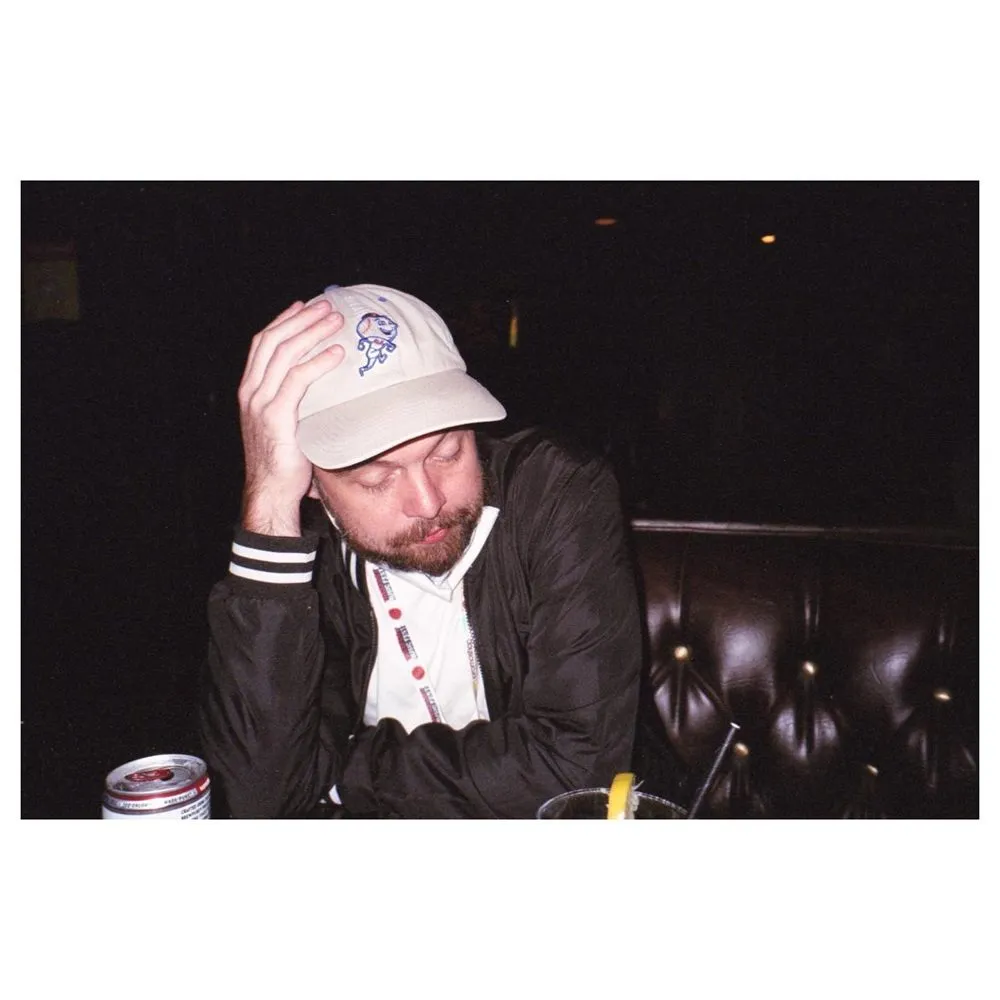
The past couple of years, Alexei Shishkin has been incredibly prolific. He has produced multiple podcasts, covering topics such as film, comedy, and politics. He also hosts The Word Cloud on Brainroat Radio, where each week he themes his playlists around a specific word. In 2023, he released Play By Ear, his debut feature documentary. It uses the Treefort Music Festival to detail the lives of working-class musicians, exploring things such as surviving on the road, planning a show, touring, DIY art, and building a loving community around music. Another venture of Shishkin’s is Rue Defense Tape Club, a quarterly, mail-order cassette compilation club that also provides a newsletter and a podcast. In 2024, he released three records, each with its own unique sound and exploring different styles of music. His upcoming record, Good Times, which was created from scratch in four days, is his eleventh full-length album and first release of 2025.
The creative process for Good Times was both similar to and different from Shishkin’s previous records. ‘There’s some where I’ll just make it at home by myself, use drum loops that I’ve got and stuff like that, and just use those as a starting point and then make it all myself,’ he reflects. ‘There’s other stuff I’ve done where I’ve gone into the studio with friends who play different instruments, and maybe I’ve written some of the structure and let them improvise and come up with stuff. For Good Times, it was unique in the sense that it was right in between those.’
Shishkin booked some time at his friend Bradford Krieger’s studio, called Big Nice Studio, to record Good Times. ‘I was like, “Dude, let’s just start with nothing and then see what we end up with after we’ve been there for 4 days,’” shares Shishkin. ‘There was literally nothing. There were no demos. Nothing. Just came in. I didn’t even bring any instruments with me. Kind of showed up, used whatever was in the studio. We had a friend of mine, Dave Kahn, who plays bass on a lot of stuff I do. He was supposed to be there, but I kind of miscommunicated with him a bit, and he was only available for half of the first day. So, I only had him for a couple of hours. He’s an incredible, incredible bassist. We were like, “Let’s just record loose bass lines.” So, we literally pulled up some drum loops that I had on the computer, and we would just play them and let him improvise over them. Mark the tempos and everything. Then we would go to the next drum loop. Mark the tempo and let him improvise over it. We may have done that for half an hour. Then we ended up with all these bass lines.’
From here, songs began to take shape. ‘Brad and I would take some of those and maybe loop them and use them as a starting point,’ continues Shishkin. ‘If we didn’t do that, it would just be me doing some random shit on the piano, and that would turn into a song. So, it was quite different in the sense that it was a process that I was very used to because when I do it myself, I improvise shit all the time. That’s just how they all happen. It was different because it was in a studio, and it was basically me and someone else coming up with the whole thing.’
Shishkin really enjoys improvising and not starting any of the songs from demos. ‘For me, I personally find it gave me more freedom,’ he says. ‘It’s a process I’m used to. I like to improvise shit, and I don’t really care to perfect it or dial it in. In the past, when I’ve shown up with demos, there have been albums where I’m like very prescriptive and like “No, this is the part. This is how I want it.” There’s also been times when I’ve just come in with my structures and gone, “Here are my structures, but you are the lead guitarist, so go ahead and play whatever the fuck you want. You find out your part. I’m gonna allow it.” I find freedom in not having structure.’
All the tracks on Good Times are short, yet delightfully dynamic, entertainingly eclectic, and intricately crafted. These tracks feature fascinating soundscapes, experimental tendencies, memorable melodies, and compelling storytelling. Shishkin prefers creating shorter songs to longer ones. ‘I’m still not very good at separating myself from the song,’ he reflects. ‘When I’m in the studio for me, since we jammed it out and we’re in the process of recording it or playing it black, I’ve heard that part already like a ton. I get bored pretty quick with the songs. So I’m like, “Let’s play the A section once, the B section once, the A section again and then jam it out and we’re done.” To me, that’s great. 1:45 or 2:15 is a great length. Then I’ll go and listen to a song, and I can’t think of an example right now, but there are songs that are literally six or seven minutes long where they are just riding one progression the whole time or one melody. They have that confidence to just be like “Yeah, I know this melody is sick and I’m gonna ride it for six and a half minutes and you’re gonna hit repeat when I’m done ‘cause you want to hear that shit again.” I don’t think I have found that kind of melody yet. That’s why all my songs are like two minutes.’
‘Disco Elysium’ has a neat little homage to the role-playing video game of the same name. Shishkin incorporated the four skill set sound effects (Intellect, Motorics, Physique, and Psyche) within the game into the track. It is one of Shishkin’s favourite video games to play. ‘You wake up as a detective who doesn’t know where he is and you’re exploring this world, meeting characters, and solving a crime,’ he comments. ‘Also, at the same time, you’re trying to learn about your own history as this detective, because you’re like an amnesiac, so you’re trying to piece together all these little clues you’re finding. Like any other game, you’re levelling up your skills. Every time you talk to somebody or encounter an obstacle, one of those four skills is tested. That’s basically the foundation of the game. You’re like building this character and trying to pass these skill checks. With those four skills, there is like a one-second sound effect associated with each one. The first like ten seconds of the song, those four sound effects happen on every second beat or bar. They’re either like slowed down or pitched down or something. But you’ll hear those four as a kind of homage to the game. So, kind of a nice little Easter egg.’
‘Ode To Carl Dennis’ was inspired by the poet Carl Dennis, one of Shishkin’s favourite poets. Shishkin took the characters from Dennis’ poem ‘At Home With Cézanne’ and reimagined them in a parallel universe. ‘I had never done that before,’ he smiles. ‘That was cool. I was like, “This is kind of a cool way to approach shit.” He did all the hard work. All I did was lift them up and put them in another spot. He’s a really good fucking poet. It’s all just contemporary stuff and slice of life stuff. He’ll always find this grander purpose in everyday minutiae. It’s really cool.’ Shishkin knew that the song’s title had to reference Carl Dennis. ‘I have to put his name on it,’ he adds. ‘He is the inspiration for that. I would have never written that kind of song if I didn’t use his work as a jumping-off point.’
Meanwhile, Dan Bejar of the band Destroyer and author Claire Donato influenced ‘Tough (Ugly Ghosts.’ ‘I just love oohs and aahs – They’re fucking awesome, and Dan Bejar uses so many oohs and aahs, and he’s always been a lifelong inspiration,’ he comments. ‘In terms of like the Ugly Ghosts thing, it is a nod to a writer named Claire Donato. She found one of my albums a while ago. I think she liked it. She followed me on Twitter. I was like, “Oh, this is sick.” She wrote this book called Kind Mirrors, Ugly Ghosts, and I was like, ‘You supported my album, I’ll support your book.’ I got her book, and I think at the time I was maybe reading it and was like, “Why don’t I put a little line about Ugly Ghosts in there or something like that.”’
‘I Like To Sit In The Cold’ is a cool guitar jam session between Shishkin and Krieger. ‘I think it was me being like ‘Dude, I want to make a call and response song,’ shares Shishkin. ‘That’s where you can see the gap in his playing and mine, where, like, he’ll be playing this fucking sick thing and I’m just like can barely fucking keep up. Then when I’m playing my parts and I’m trying to lead, he’s just like keeping up flawlessly.’
One of the standout tracks from the record is the surreal, Grandaddy-ish ‘What Magic Is’. ‘Brad led the way with the guitar parts on that, and then I was doing more of those, like little twinkly synth things. I can see it kind of sounding like Grandaddy,’ states Shishkin. ‘Mostly on that one, I was like, “Let me try and play with weird little synth presets.” Honestly, I think that’s what it was. Then there’s a break in the middle where everything stops, and you just hear the synths, and then you can hear Brad. I believe we were like, “Man, we should just put some random fucking words in here to make it sound like something meaningful.” He was like ‘That’s what magic is.” We were like “Fuck it. Let’s just roll with that.” That one has no meaning; it’s kind of an absurdist song. Let’s take words, put them together, and make it sound like there is something there, but in reality, it’s just words.’
The gnarly guitar riff, with a deliciously dirty tone, that opens ‘Invincible’ was one of the last things added to the song. ‘I just started playing synth lines that went along with Dave’s bass or finding chords that fit or something,’ explains Shishkin. ‘That guitar that comes in that are fucking loud chords, it’s a loud tone, but it’s like controlled. That didn’t come in until later. Brad played that last. We were like, “This is a really great motif. Let’s just throw it in the beginning, make that the intro, and use it a bunch.” That one started with just a bassline, and what I really like about that song is at the end, where it almost feels like an arena rock thing at the end. I like that because it kind of gets going.’
‘Baltimore’ is the lone song on the record with a city’s name as the title. Baltimore actually has no special significance to Shishkin. It spontaneously made its way into the song while he was writing the lyrics. ‘I have never been to fucking Baltimore; that song has nothing to do with Baltimore,’ he laughs. ‘I guess the characters in it are driving past Baltimore. But in reality, that one, I just picked a phrase like a common idiom, nothing less, nothing more, and I just started writing things that would work with it – straight up, we wrote this instrumental, and I needed to put words to it. I was like, “Well, let me just pick phrases that work.” Baltimore worked its way into it, and now I guess I have to go to Baltimore at some point.’
Good Times means a lot to Shishkin. ‘When I was up there and we were recording it, I had an inkling that it could be the last one up there,’ says Shishkin. ‘I don’t know if you ever get those feelings sometimes when you’re like doing something and you’re like “Damn. This is really cool that we get to do this and that everyone who is involved that their circumstances are what they are right now and we’re able to do this.” To me, it represents personally growing up a little bit and getting older. That’s why I really like putting out music every year, because you can kind of see how things track. In the past, I’ve gone up there before to Big Nice with friends who are photographers and friends who play music. Slowly, that number dwindled because people have real life that they have to get to.’
Good Times is set to drop on September 5th. ‘The name of the album just came from a throwaway track where Brad had recorded me playing piano randomly,’ says Shishkin. ‘I didn’t even realize he was recording it, and he threw it on a drive, and when I got to listening to the tunes, I was like “What the hell is Good Times?” I played it back, and I was like, “Oh, Shit. That’s cool. Those were good times. That was a fucking awesome trip.” That’s kind of where it all came from. So, it means to me just what it says. It was good times up there.’
Photo Credit: Graham Bell